Laser Cleaning & Laser Machine FAQ (Texas)
Looking for mobile laser cleaning services in Texas or comparing laser cleaning machines?
Here are the most common questions we get about laser rust removal, laser paint removal, and laser ablation.
What is laser cleaning?
Laser cleaning (also called laser ablation) is a process that removes rust, paint, coatings, oil, oxidation, and contaminants using controlled laser energy.
It’s a dry process that can precisely clean a surface without harsh chemicals or abrasive media.
How does laser cleaning work?
A laser beam targets the unwanted layer (rust/paint/coating/contamination). The material absorbs the energy and breaks away from the surface.
Settings are tuned for the substrate so you remove the layer you want—while minimizing impact to the base material.
Is laser cleaning safe for metal?
When the correct laser type and settings are used, laser cleaning is widely used on steel, stainless, iron, aluminum, and other metals.
The goal is controlled removal of surface contamination while preserving the underlying substrate. A test spot is the best way to confirm results.
Can laser cleaning remove rust completely?
Yes—laser rust removal can take light surface oxidation down to clean metal, and it can remove heavier rust in layers.
Final results depend on rust depth, pitting, access, and the finish you want (bare metal, prep profile, or ready-to-coat surface).
Can laser cleaning remove paint, powder coat, or coatings?
Yes—laser paint removal can strip many paints and coatings, including some powder coats, without blasting media.
The best approach depends on coating type, thickness, and substrate. For sensitive parts, laser cleaning can be more controlled than abrasive methods.
Will laser cleaning damage the base material?
Not when it’s set up correctly. Laser cleaning is adjustable (power, frequency, pulse width, scan pattern, speed), so we can target the contamination layer.
We typically start with conservative settings and perform a small test area to confirm the outcome before scaling up.
Does laser cleaning create heat or warping?
Laser cleaning can generate localized heat, but with proper settings it’s designed to avoid excessive thermal impact.
Thin materials, edges, and unknown alloys should be approached carefully with test patches and controlled parameters to reduce risk of distortion.
Is laser cleaning better than sandblasting?
It depends on the job. Sandblasting is fast for large areas but creates media mess and can be aggressive.
Laser cleaning is precise, low-media, and excellent for restoration, detailed parts, selective coating removal, and situations where containment matters.
Is laser cleaning eco-friendly?
Laser cleaning is typically a dry process with no blasting media. That can reduce waste, cleanup, and secondary contamination.
You still need safe collection/filtration of removed material (like paint dust or rust) and proper PPE—especially on older coatings.
What surfaces can you laser clean?
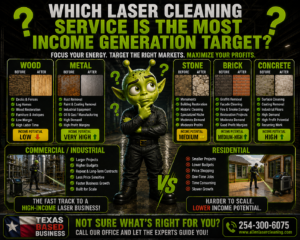
Common substrates include steel, stainless, cast iron, aluminum, stone, brick, and some wood applications (job-dependent).
We laser clean equipment, machinery, weld areas, automotive parts, frames, tools, molds, graffiti on masonry, and restoration projects.
Can laser cleaning be done on-site (mobile) in Texas?
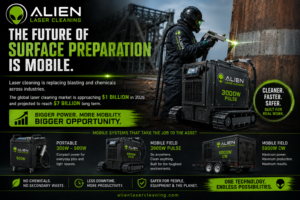
Yes—many projects are done with mobile laser cleaning where the work is: industrial sites, job sites, shops, and facilities.
On-site feasibility depends on power availability, access, containment needs, and the type of material being removed.
How much does laser cleaning cost?
Pricing depends on the material being removed, surface area, access, rust/paint thickness, setup/containment, and travel.
Some projects are priced hourly; others are per job. The fastest way to get an accurate quote is photos/video and a short description of the goal finish.
How long does laser cleaning take?
Time depends on removal type (oil vs rust vs thick coatings), the finish you want, and the size/complexity of the part.
A small test area tells you the realistic removal rate and helps plan labor, scheduling, and project cost.
What is the difference between pulsed laser cleaning and continuous-wave (CW) cleaning?
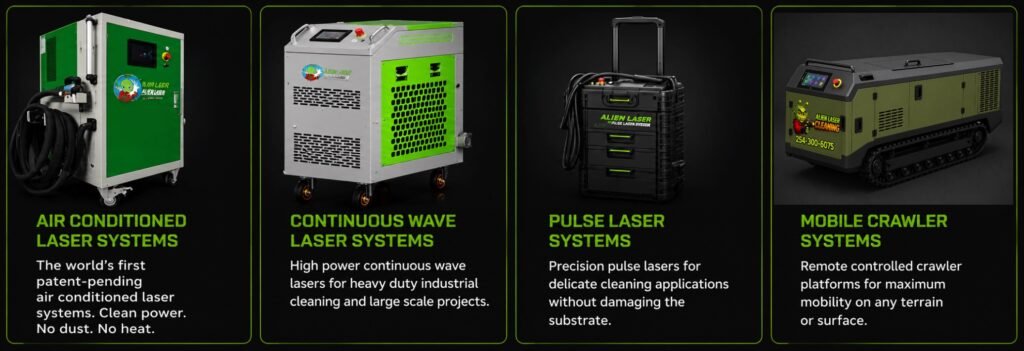
Pulsed lasers deliver energy in short bursts for controlled removal and are commonly used for rust removal, restoration, and selective coating removal.
CW lasers are often used for faster large-area work in some industrial cases. The “best” choice depends on substrate sensitivity and the removal target.
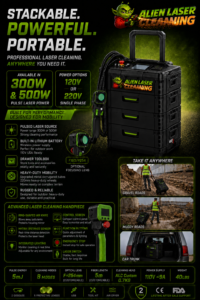
What size/power laser cleaning machine do I need (100W, 200W, 300W, 500W, 1000W, 2000W)?
Power selection depends on your typical jobs: light oxidation/detail work vs production-scale coating removal.
Higher power can increase throughput, but correct settings and technique matter just as much. Tell us what you clean most often and we’ll recommend the right range.
Can a laser cleaning machine run on 110V or 220V?
Many portable laser cleaning systems can be configured for standard shop power, while higher-power units may require 220V (or more).
Exact requirements vary by machine design, cooling method, and laser power—always confirm before purchase or job site deployment.
What maintenance does a laser cleaning machine need?
Typical maintenance includes keeping optics clean, inspecting cables/connectors, monitoring cooling performance, and following manufacturer service intervals.
Proper storage, ventilation, and operator training help extend component life and keep cleaning performance consistent.
Do you offer training for laser cleaning operators?
Training is strongly recommended for safe operation, better cleaning results, and consistent production.
A solid training program covers laser safety, parameter setup, scan patterns, substrate considerations, PPE, and jobsite containment practices.
What safety gear is required for laser cleaning?
Laser safety glasses matched to the laser wavelength are essential, plus gloves and protective clothing as needed.
Many jobs also require respirators or dust control depending on what’s being removed (paint/coatings). Safety requirements depend on the application and environment.
Can laser cleaning remove grease, oil, and soot?
Yes—laser cleaning can remove oils, soot, carbon, and production residues, especially in industrial maintenance and manufacturing environments.
Containment and filtration are important when removing residues that can become airborne during cleaning.
Can you laser clean automotive parts, frames, or restoration projects?
Yes—laser cleaning is popular for restoration because it can clean precisely around details and edges.
We commonly see frames, brackets, suspension parts, engine components (job-dependent), and classic vehicle restoration work.
Do you sell laser cleaning machines as well as provide services?
Many companies offer both: mobile laser cleaning services for clients who want work done, and laser cleaning machines for customers who want to bring cleaning in-house.
If you’re deciding, we can compare service vs purchase based on your monthly workload and ROI goals.
How do I get a laser cleaning quote in Texas?
Send photos/video of the surface, the type of material you need removed (rust/paint/coating/oil), location, and the finish you want.
We’ll recommend the best approach, provide an estimate, and schedule a test spot if needed.
Want a fast quote or machine recommendation?
Contact Alien Laser Cleaning for Texas mobile laser cleaning, laser rust removal, laser paint removal, and laser cleaning machines.